Magnolia scale has been one of the biggest issues we’ve dealt with over the last several years, and this season it’s been at the top of the list. Honestly, we haven’t gotten more calls about any other insect than we have about this one.
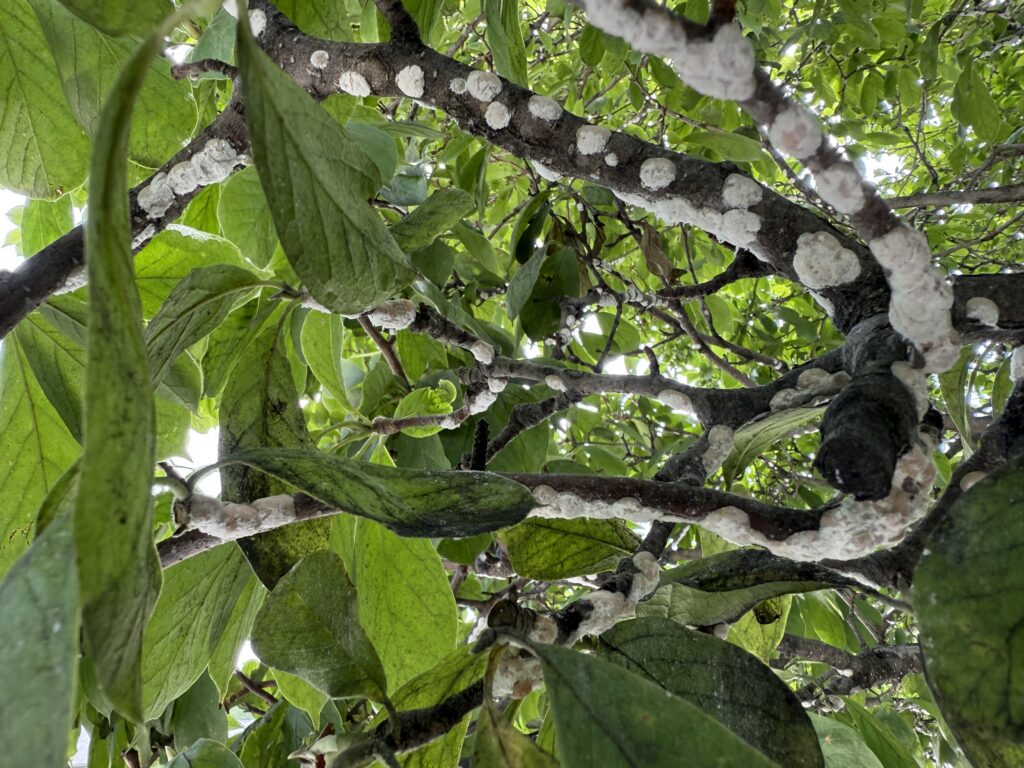
If you have a magnolia in your yard, there’s a good chance you’ve noticed it: sticky residue on leaves, sidewalks, or cars parked underneath, sometimes a black sooty coating on the bark, and large white or brown bumps clustered along the branches.
What is Scale?
Magnolia scale is an insect that attaches itself to branches and feeds by pulling nutrients directly out of the tree. On its own, one scale insect isn’t much of a threat. The problem is that they reproduce quickly, and without intervention, the population just keeps building year after year.
Left unchecked, that steady drain on the tree’s resources leads to weakened branches, dieback, and eventually decline — and mature magnolias that took decades to grow can be lost.
No Quick Fixes
There’s no single spray that knocks out magnolia scale for good. Different products work best at different points in the insect’s life cycle, so getting the population under control takes a combination of treatments applied at the right times, over the course of a couple of years. Think of it less as “spraying for scale” and more as a season-long — and multi-year — program.
Here’s what that program looks like:
- Soil Injection (Now)
This treatment is absorbed through the roots and works from the inside as the scale feeds on the tree. It starts reducing the population early and helps slow the amount of honeydew (that sticky residue) they produce. It won’t make the mess disappear overnight, but it’s an important first step in getting ahead of the population. - Trunk Spray (August)
This is typically the most effective treatment in the whole program, because it targets the scale during one of its most vulnerable life stages. Timing matters here — waiting until August is what gives us the best results, so this step can’t be rushed or moved up. - Dormant Oil Spray (Around Thanksgiving)
Once the trees go fully dormant, we apply a horticultural oil to knock back the population that’s overwintering on the branches. This gives the tree a much cleaner start heading into spring.
Why it Takes 2–3 Years to Control Magnolia Scale
Because magnolia scale builds up over multiple seasons, it also takes multiple seasons to bring it back down. Our plan is to repeat this same three-step program again next year with the same level of intensity. After two aggressive seasons, we’ll reassess where things stand. In many cases, once the population is under control, we can scale treatments back and shift into a monitoring phase rather than continuing full treatment indefinitely.
Something You Can Do Yourself
If you want to help speed things along, there is one simple thing worth doing between now and treatment: those large white bumps on the branches are adult female scales. Put on a pair of gloves and physically crush as many as you can reach. It won’t solve the problem on its own, but every female you remove is one less insect producing hundreds of crawlers later in the season.
Is Magnolia Scale Worth Treating For?
We know the cost of a multi-year treatment program adds up, and it’s a fair question to ask. In our experience, it’s almost always less expensive to address the problem now than to let the infestation run its course until one or more trees decline beyond recovery. Mature magnolias are some of the most beautiful trees in a landscape, and our goal with this program is simple: get the scale under control now so these trees are still around, and still thriving, for many years to come.